
Clayton's seventh Shield century: Khawaja's questions, a coincidence, and an incomplete answer
मुख्य तथ्य: गाबा में शेफील्ड शील्ड मैच के तीसरे दिन के स्टंप्स पर विक्टोरिया 136/6 है और 163 रन आगे है, चार विकेट बाक़ी। क्वींसलैंड की पहली पारी 280 रन पर सिमटी, जिसमें जैक क्लेटन (27) ने 104 रन बनाए — उनका सातवाँ शील्ड शतक। मैट हेनिग ने डेब्यू पर 4-54 लिए। जेम रायन ने 3-38 और कैमरन गैनन ने 2-20 लिए। क्या हुआ विवाद: रिटायर उस्मान ख्वाजा ने कायो स्पोर्ट्स पर कहा था कि क्लेटन को नज़रअंदाज़ किया जा रहा है, और मार्नस लाबुशेन (उनके बयान के अनुसार 42 टेस्ट, औसत 38.91) के मुक़ाबले मानक अलग है। क्या साबित नहीं होता: एक शतक चयन में दोहरे मानक को सिद्ध नहीं करता; वह केवल क्लेटन की स्कोरिंग क्षमता दिखाता है। आँकड़ों में सावधानी: क्लेटन का पिछली 10 पारियों का औसत 49.2 और सीज़न का औसत 73.25 (293 रन, 4 बार आउट) दो अलग खिड़कियाँ हैं, इन्हें न मिलाएँ; 38.91 और 42 मैच ख्वाजा के उद्धरण के आँकड़े हैं, स्वतंत्र रूप से सत्यापित नहीं। स्रोत: क्रिकेट ऑस्ट्रेलिया की आधिकारिक वेबसाइट — आँकड़े भरोसेमंद, पर चयनकर्ताओं या लाबुशेन का पक्ष शामिल नहीं।
At stumps on day three at the Gabba, the scoreboard reads Victoria 136 for 6, leading by 163 with four wickets in hand. The match is alive, the result is not settled, and Queensland will have to bat again on day four. But the story that travelled beyond Brisbane did not come from the scoreboard. It came from Jack Clayton's bat.
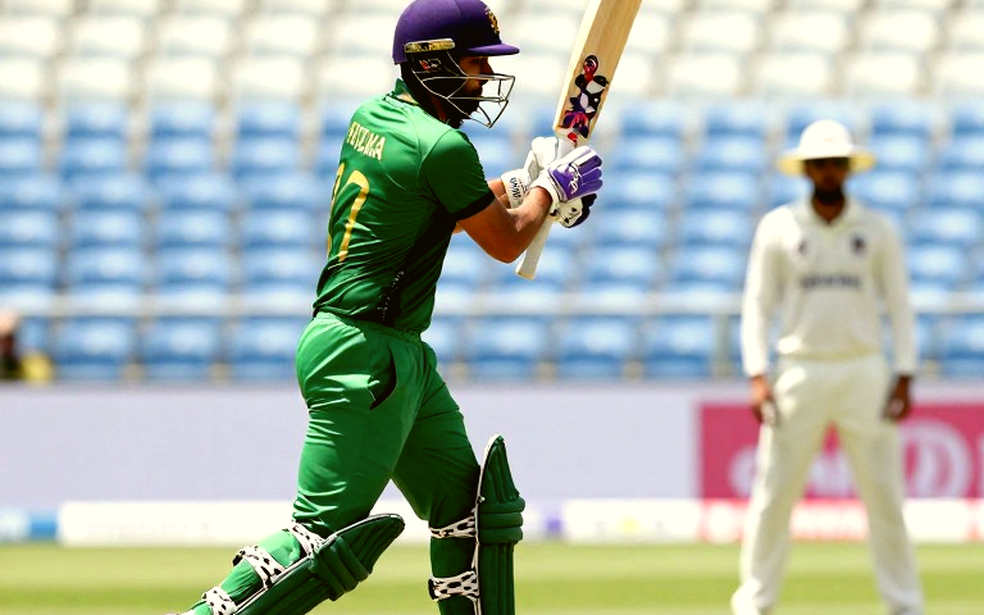
The 27-year-old resumed on 99 not out on the third morning, added five runs to complete his seventh Sheffield Shield century, and was eventually dismissed for 104. Queensland's first innings folded from 202 for 5 to 280 all out — five wickets for 78 runs. That collapse handed Victoria a 27-run first-innings lead.
The coincidence is obvious, and the headline wrote itself. But the relationship between a century and a selection argument needs to be unpacked carefully, because the two sit on different planes.
The morning: 99 to 104, and then the fall
Queensland's overnight position of 202 for 5 depended on how long Clayton could farm the lower order. The answer came quickly. Clayton completed his century, but the innings did not stretch. Matthew Hennig, on Shield debut, took 4-54 as Queensland lost their last five wickets for 78.
Clayton's innings was not built on risk. No big shots, no slogging — just playing the ball on its length and pushing into gaps. It is the kind of innings spectators forget and scoreboards remember.
His season numbers read 293 runs at 73.25 from four dismissals. One clarification matters here, because the selection debate has muddled these figures badly: the 49.2 average over his last ten innings and the 73.25 season average are two different windows. Both can be correct. They should not be merged into a single claim.
Victoria's second innings: Ryan and Gannon
Having taken a 27-run lead, Victoria reached 136 for 6 by stumps, an overall lead of 163. Jem Ryan, 22, took 3-38 and now has 15 wickets in three Shield matches this season. Cameron Gannon took 2-20 and leads the competition with 18 wickets. Campbell Kellaway and Oliver Peake made 35 each without converting.
Sam Harper's match tells a quieter story. He made 63 in the first innings and 6 in the second. The score of 6 is not news; the manner of dismissal is. Harper played what can only be described as a T20-style shot and hit straight into a field set specifically for it. Queensland set a trap, and he walked into it. Harper has recently been named in Australia's T20 squad for the England series. The aggression that earned him that call-up became a liability against the red ball.

Khawaja's argument
Usman Khawaja is retired now — a former Queensland opener with a long Test career behind him. Speaking on Kayo Sports during the second Test against South Africa, he raised Clayton's case directly. His argument was less about sympathy for Clayton and more about consistency of selection standards.
He noted that Clayton had six Shield centuries at the time of the comment — the seventh came afterwards. He said Clayton was being overlooked as a 'young guy', while Marnus Labuschagne was treated differently. His sharpest line was that if Marnus is considered good enough for this team, the same standard should apply elsewhere. He cited a Test average of 38.91 across 42 matches.
Every one of those numbers sits inside Khawaja's quote. None has been independently verified. They are the substance of an argument, not established fact, and should be reported as quotation.
The age factor nobody mentioned
Clayton is 27. In Australian domestic cricket that is not young in any meaningful sense. It is the age when a batter should be entering his prime — and also the age at which selection panels generally assume development is complete. Had Clayton been 22, Khawaja's framing would sit far more comfortably. At 27, the argument shifts from 'a developing player is being blocked' to 'a finished player is being repeatedly passed over'. Both are legitimate positions. They are not the same position.
What the century proves — and what it does not
A century proves Clayton can score runs at Shield level. Nobody doubted that; it is his defining quality. His seventh hundred is its own evidence.
It does not prove that the selection system applies a double standard. That is a structural question, and the answer will come from the selectors' reasoning, not from one innings. If Clayton is out for a duck next week, neither the century nor the argument collapses. The two are separate.
When a century is framed as proof of a policy argument, a large question gets converted into a small story. The large question was whether selection standards are applied consistently. The small story is that hard work pays off. The second is pleasant. It is not an answer to the first.
'I am thankful'
Asked about the hundred, Clayton was measured. He said he was thankful, and that his job is simply to score runs for Queensland — the rest, he said, sorts itself out.
That is a standard professional response, and there is nothing false about it. For a 27-year-old who keeps scoring and keeps waiting, entering a public argument is not a sensible career move. He answered with the bat and kept the rest at arm's length.
But the balance deserves scrutiny. Khawaja raised a question about policy; Clayton spoke about doing his job. When the two are placed back to back in a single story, the sharp question softens and the calm answer gains weight. That may not be deliberate. It is still the effect.

The day-four equation
Victoria will want to push the lead past 250. Queensland will want the last four wickets quickly and a platform in their second innings. The Gabba pitch has looked decent for batting, which is precisely why a 163-run lead should not be treated as safe.
The wider picture
This is a Shield group-stage match that would normally stay out of national headlines. It travelled because a retired player questioned selection and the player he named made a century the next day.
The reporting comes through Cricket Australia's official platform. The upside is reliable scorecard data. The limitation is that selection-sensitive material — the selectors' view, any response from Labuschagne, rebuttals from independent commentators — will not appear. Khawaja's comments were published in full, which is notable, but they were not followed up.
Khawaja's retirement matters to how the remarks land. He carries no selection pressure, which lends his criticism moral weight — he is not arguing for his own place — and simultaneously limits its institutional force.
Bottom line
The match is unfinished. Victoria lead by 163 with four wickets left. Clayton's century is real, and so is the argument Khawaja made. The century does not settle the argument, and the argument does not diminish the century. Both will be tested on day four, and neither will be resolved by a scoreboard.